Today’s Globe and Mail features the first of the three-part personal story by columnist Ian Brown about his 11-year-old son Walker: The Boy in the Moon. Walker has a rare genetic condition called CFC, which makes our life with Jon looks like a walk in the park.
That said, Ian Brown much of the big picture echoes with our experiences. A couple of quotes that struck me:
For eight years, every night is the same. The same routine of countless details, connected in precise order, each mundane, each crucial.
The routine makes the eight years seem longer, until afterward, when because of the routine the years seem to have evaporated.
and, something that readers of this blog should bear in mind when reading any of my missives:
This isn’t a list of complaints. There’s no point to complaining. As the mother of another CFC child once told me, “You do what you have to do.” If anything, that’s the easy part.
His description of the fights over night-duty between he and his wife, both desperately sleep deprived, ring a bell (though I daresay Laura is more forgiving—or maybe it’s just a lack of anvils at hand).
The one sentence that was totally out of my experience and knowledge was:
The house was a well-organized nightmare. You couldn’t survive as the parent of a handicapped child if you weren’t organized…
I hate to contradict, but our house is just the nightmare part.
Last night, courtesy of Grandma, we went to see the John Doyle production of the Sondheim musical Sweeney Todd: The Demon Barber of Fleet Street. This has been my favourite musical for years, and I’ve seen the televised original production and pretty much memorized the CD, but I’ve never actually seen it live on stage. Well, this is the version to see: it pretty much blows away any other traditional sort of staging, and it’s easily the best theatrical production that I’ve seen in years.
The show features a stripped-down cast (10 actors), and a stripped-down orchestra (10 musicians). The show further economizes on salaries by having the actors be the musicians! All play at least one instrument, and when they’re not featured in a scene (and even when they are) they are playing an eclectic orchestra featuring such diverse instruments as accordion, cellos, tuba and glockenspiel. This is no mean feat, since Sondheim’s score is intricate and challenging to play, but amazingly neither acting skills or musicality is sacrificed one whit. Though stripped down, the orchestrations never sound chintzy or bare, and with the company in full play and voice, the sound they produce is surprisingly lush. The actors never leave the stage during the performance, and even play their instruments wholly in character.
The cast is, without exception, terrific and very experienced (no newbies here “in their first professional stage role”, unlike in many touring shows). The whole show is framed by the rather high-concept conceit of staff and inmates of an asylum performing a show, but it manages to give the piece intensity and a rather unsettled madness to the whole work. This is enhanced by the non-naturalistic staging: often the characters don’t face each other while conversing, and instead look out into the audience (which is understandable since they might be sawing away on a cello or violin at the same time.)
We both came out of the theatre exhilarated by the show. Peter said it was the best theatrical experience he’s had since we saw the play Copenhagen over three years ago and I would definitely agree! If you have the slightest interest in theatre, and can take your musicals decidedly black, go see Sweeney Todd. It ends December 9th at the Princess of Wales Theatre.
Yesterday was Photon and my final class of beginner Agility at Who’s Walking Who. It was a nice, small class (four dogs and their handlers), but Who’s Walking Who really has to work on their registration system: I didn’t know until the day of my first class whether there was a class or not, and whether or not I was in it!
For those who don’t know, dog agility is the kind of stuff that the Superdogs do: jumping over hurdles, running through tunnels, over seesaws etc. through a set course. The dog’s handler runs alongside, guiding the dog through all the stations. Unlike flyball (another dog sport), the dog and handler are equal partners, playing as a coordinated team.
Learning the Equipment
Each class of the six-week session had dog and handler learning a different agility apparatus, set at a much easier level than in an actual trial: The jumps were only about 6 inches high; the see-saw board tipped maybe 2 inches up and down; the A-frame was only about 4 feet tall rather than 7 feet.
The first event we started learning was the weave poles, since it is the hardest for the dog (and human!) to figure out. Several of the other students actually bought practice poles for home. (Photon did reasonably well at the poles considering that we never practised outside of class.) She was game for all the events, even the towering A-frame, which many dogs balk at the first time.
The Hard Part
When we weren’t practising on the equipment, we were learning basic handling techniques. I had a few problems with a few of the instructions: We were encouraged to entice and wind up our dogs with a tug toy, and have them excitedly play with that after we had successfully completed a task. This is to get the dog super-excited about doing the events. The problem with this technique is that 1. None of the dogs in the class were particularly toy-driven to start with. Photon likes her toys, but plays with them in a more business-like fashion. She’s more food movitated. 2. It tends to get dogs to go hyper and crazy about their toys, which I don’t like.
The third class was especially difficult for Photon and me. I made the mistake of feeding her her entire dinner, so she wasn’t particularly hungry (there goes the food motivation). Also, she—in the throes of adolescence—decided to “forget” all of her previous training, to the point of totally ignoring me, not sitting, not coming, nothing. The instructor was actually a bit nonplussed, since Photon was always pretty good up to this point. I got ticked off at her; she got sulky. I was ready to pack it in then and there, deciding that agility just wasn’t for me, but hung in anyway.
Final day
We ended the final class doing our first run-through of a short agility course (we’d previously only worked on individual apparatuses). Here’s a video of us shot by Peter (who came with Jon for the last class to see what we had been doing.):
The blue barrel is actually the entrance of the tunnel event. There should be a cloth tunnel attached to it that the dog must run through. Photon learned the table event (jump on table, lie down before going on to next event) about half an hour previously (we missed that class), which was impressive! If you’re wondering what happened at the finish of the A-frame, she’s supposed to touch a small target at the bottom, which I completely goofed up. This is to ensure that the dog slows down enough to touch the yellow part (as opposed to jumping off the A-frame from halfway up.)
Final impressions
As opposed to some of the iffy previous days, the final class left me with a good feeling about doing agility. The instructor refrained from too much criticism (left us feeling confident), and had us run the whole course only once (left us wanting more!) I have no idea whether I’m going to take any more agility courses or not (certainly not before the new year, even though one starts next week), but I’ll think about it!
I had a great weekend. On Sunday I watched Wonder Pets. The Wonder Pets were on TV at four o’clock. After watching Wonder Pets my family and I went to a restaurant. The restaurant was Il Fornello. At Il Fornello I had shrimp pizza. I like to have some salad as an appetizer. When I got home I watched a video and then went to bed.
I saw a truncated version of this blog post circulating the dog boards a while back, but friend Bev directed us to the original article. (Warning: occasional coarse language.) It’s a funny and accurate depiction of dogs, from their perpetual hunger to their noses getting out of joint when one of their people leaves for a while.
One thing about having a thinking dog is that they can and do hold grudges. Peter’s childhood border collie Daisy got downright shirty with me when Peter and I started going out together. (One time when we were snuggling on the couch Daisy gave us a filthy look, growled, and slunk away to another room.) Miss Photon holds a grudge against us on the relatively rare occasion that we get angry at her. After a particularly disastrous agility class a couple of weeks back (where I got quite sharp with her) she wouldn’t go near me and sulked on her bed (while I sulked in my office). After a bad walk in the dog park where she’s “forgotten” her recalls or heeling, she’ll avoid Peter or me—whichever person it was who walked her and growled at her—and hang out with the other person. For a while.
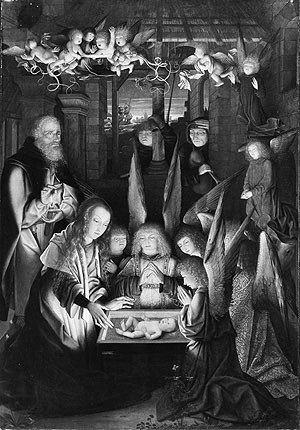
The Adoration of the Christ Child
16th c. Flemish painting by unknown artist, at the Metropolitan Museum of Art
The angel next to Mary—and possibly the middle shepherd—appears to have facial characteristics typical of Down syndrome: flattened mid-face, epicanthal folds, nose and mouth shape, and short fingers. It could be Europe’s earliest representation of Down syndrome. The authors also make an interesting conjecture about how this may have reflected on society’s view of people with Downs back then:
It is possible that those with milder degrees of mental handicap were not recognised as having what we now call mental retardation; individuals who were perceived as being slightly slow, in contrast to those with severe handicaps, might have been fully integrated into society. In this context, a surviving teen or adult with Down’s syndrome, no life-threatening malformations, and relatively high intellectual function might not have been recognised as sufficiently different to warrant unusual treatment in a social context.
Thus, the individual or individuals in this painting could have been only mildly affected, or mosaic. He or she, or they, could well have been beloved or at least accepted in a family or village group, even a member of the unknown artist’s family.
After all the speculations, we are left with a haunting late-medieval image of a person with apparent Down syndrome with all the accoutrements of divinity. It is impossible to know whether any disability had been recognised or whether it simply was not relevant in that time and place.
 Today’s Globe and Mail features the first of the three-part personal story by columnist Ian Brown about his 11-year-old son Walker: The Boy in the Moon. Walker has a rare genetic condition called CFC, which makes our life with Jon looks like a walk in the park.
 Last night, courtesy of Grandma, we went to see the John Doyle production of the Sondheim musical Sweeney Todd: The Demon Barber of Fleet Street. This has been my favourite musical for years, and I’ve seen the televised original production and pretty much memorized the CD, but I’ve never actually seen it live on stage. Well, this is the version to see: it pretty much blows away any other traditional sort of staging, and it’s easily the best theatrical production that I’ve seen in years.
 Nov. 26/07