Math, so far…

Jon and his Mathline

Laura During Jon’s whole academic career so far his teachers have always commented on the huge differences between his strengths and weaknesses. His strengths have always been basic word skills; his spelling level has been only slightly lower than his proper grade level, and his reading ability certainly outstrips by several grade levels his actual comprehension of the material.

On the other hand, the one subject where Jon has had very little success is arithmetic. He just never “got” addition and subtraction. For the longest time he assumed that there was some sort of trick to it, that there must be some way of spelling the numbers to get the right answer. He never really understood that addition requires a lot of rote memory—that 2 + 1 always equals 3. For years when asked a simple sum he would answer by randomly guessing a number. As well, most math aids required either visual acuity or manual dexterity, both of which Jon had in short supply.

Tami, Jon’s wonderful teacher who helped him successfully crack the nut of reading several years ago, didn’t stress math too much as she felt (and rightly so) that she should strike while the iron was hot and make as much literacy progress as they could. Unfortunately, then followed a couple of teachers who tried to develop Jon’s social interaction side—somewhat to the detriment of academics, especially in math.

Mathline The last teacher did, however, find a couple of math aids that piqued Jon’s interest: The Mathline number line (sort of a mashup between a number rod and an abacus) and the Think-It-Through Learning System, which uses a shallow case with tiles that you use to answer simple math problems from a booklet. When you’re done with the 12 questions, you flip the case over to see if the coloured shapes on the back match the pattern on the answer key.Think it Through system Jon loved doing his “math puzzles” at school, so we bought a set and number line over the summer*. We were delighted to see Jon starting to memorize certain 1-digit sums (+1; +2; as well as doubled numbers, e.g. 3+3, 4+4, etc.) and hearing his excited yell, “I didn’t have to use the number line!”. Now he’s starting to lock in addition combinations that are less regular. He’s starting to get the commutative property too (3+6 = 6+3), but that’s not fully there. He doesn’t quite see it as a freebie, yet.

Since the summer Jon’s started the new school year with a new teacher who’s pretty gung-ho on the academics. All of a sudden, Jon’s been coming home most nights with homework in new subjects (for Jon) like history and geography, as well as reading comprehension. As for math, we were gobsmacked when we visited the classroom and saw the teacher whacking his pointer on various 3-digit numbers on the board and asking Jon to expand them (e.g. 341 = 300 + 40 + 1). And Jon was shouting out rapid-fire answers like no-one’s business. Even when it wasn’t his turn to answer. Nerd!

We were even more astounded three weeks later when Jon came home with homework of adding two 2-digit numbers together. We figured this was way too advanced for Jon and had to be a mistake (especially since it was sent by a substitute teacher that day). No mistake: After thoroughly learning about expanding numbers and place values, Jon was now able to do 2-digit column addition: Add up the ones column (using any sort of calculation aid if necessary), carry over the 1 to the tens column and add those up to get the answer. With the help of his number line, Jon roared through almost 20 addition problems, smiling all the way. Amazing!

* Because of Jon’s specialized needs, we’ve had to buy a lot of things online. With a few exceptions, most of our purchases end up being from mom-and-pop vendors from the US. Unfortunately, looking for some of these educational tools online is kind of creepy because you have to wade through a lot of home-schooling websites (and their attendant weirdness) to find the vendors. Talk about an alternate universe!

Just one more thing

PeterLaura It’s been a while since we’ve had any new concerns about Jon to worry about, but after our latest appointment with his orthopedic surgeon, now we do. The latest x-rays reveal that Jon has scoliosis, a lateral curvature of the spine.

Skeletal distortion is not uncommon in people with cerebral palsy: because of damage in the nervous system, their muscles are often “turned on” constantly. (As a mental exercise, tense some of your muscles, then imagine that it’s a permanent condition. But it needn’t be so complete: perhaps it is just a section of muscle, or a fraction of the fibres in one particular area.) This constant muscular pressure can be intense enough, over time, to gradually distort bones. Jon already shows some skeletal distortion, primarily in his feet and legs. But there is something slighly unnerving about seeing this distortion in the spinal column, in black and white on the x-ray.

How exactly is Jon’s CP affecting his spine? If we run our hands along Jon’s spine it’s easily felt that there’s a bulge of muscle running down the spine on the left, but not on the right. The bulge is a regularly-innervated lateral band of muscle; the other side’s muscles reflect where those particular neurons got damaged at birth, so can’t be used to articulate those back muscles. And so they can never develop.

Gradually over time, a small section of strong muscle has pulled and twisted the lower vertebrae. According to the doctor, the scoliosis has been developing longer than its sudden appearance suggests. Those muscles have been tugging subtly behind the scenes for a while, too subtly to be seen in the past by physical observation. No doubt its dramatic entrance to the big time is due to the sudden adolescent growth spurts and the increased weight of his torso that has to be supported (as you grow two-dimensionally, your proportion of weight grows three-dimensionally).

So what’s to be done? Exercise is always good, and Jon certainly needs more than he’s been getting. We and our school physiotherapist are trying to get a number of things happening when he’s at school. But it won’t undo the curvature already present, and won’t realistically stop any increasing distortion. Braces have little effect on kids with CP, since the huge pressure on the vertebral column is internally generated and won’t be stopped by a mere brace. Jon’s spine curvature isn’t severe enough for surgery. So basically there isn’t really anything we can do other than watch and wait until his teenage growth spurt finishes. Only then will we be able to determine whether his scoliosis has grown severe enough to necessitate an operation or any other kind of intervention.

Just one more worry in the all-you-can-eat buffet of concerns that is Jon’s life.

The Boy in the Moon, revisited

Laura A couple of years ago we posted (here and here) about Globe and Mail writer Ian Brown’s heartbreaking series of articles about his severely disabled son, Walker. Although most of Walker’s disabilities are much more profound than anything we’ve encountered, Brown wrote about issues, feelings, and thoughts that had an eerie resonance with us.

Brown has now expanded the articles into a book, The Boy in the Moon: A Father’s Search for His Disabled Son. An excerpt was recently posted on the Globe‘s site. Again we saw a disquieting parallel with our own life, when Brown writes about his home’s storage of huge amounts of old supplies and equipment, kept just in case they might be needed again. Also, rooms filled with unused clothing and toys (given to Walker by well-meaning relatives) that the family can’t bear to get rid of.

We have shelves and toyboxes filled with wonderful toys given to us by friends and relatives over the years—stuffed animals, puzzle games, Lego sets, trucks—that we hoped would get lovingly used and destroyed by Jon. Unfortunately he never had much interest in plush toys, trucks or games; and lacked the manual and visual dexterity for Lego and puzzles. But we couldn’t bring ourselves to get rid of them, rationalizing that maybe, one day he’d want to play with them….

Old toys
One of several old toy depositories littered throughout our house

Revisiting the Kakapo

Peter Way back when we created our kids’ science book Born Smart? (yes we are getting back to updating it here, it’s been a busy year), we had a chapter called Problems with Instinct. One of the animals we talked about was the kakapo, a large, gorgeous, flightless parrot from New Zealand. We’ll let the pages below, currently in different states of restoration, expand on the kakapo’s problems.

Born Smart page 99

Born Smart page 100

Why do we bring this up now? Well, what initially brought the kakapo to our attention was the book Last Chance to See by Douglas Adams and Mark Carwardine. Almost 20 years later, Carwardine and Stephen Fry (in place of the late Mr. Adams) retraced their steps to see how or if some of the animals have coped since. The TV show is just out in Britain, and look! here’s an old friend very happy to see zoologist Carwardine! Oh so happy!

Bathroom Reno

Laura Another epic post! While we were away in Quebec we started the process of revamping our upstairs bathroom. This wasn’t a purely cosmetic change. Rather, because Jon is getting so big it’s become necessary to start making accessibility modifications to help him take baths without wrecking Mom and Dad’s backs.

Good advice

The best tip Peter ever got from a contractor specializing in accessibility issues was: Put a thick sheet of plywood all over the wall studs before you put the drywall up. That way, you can put grab bars wherever you want without having to locate studs. With that in mind we had contractor pal Mike (and his assistant Neil) do just that, ripping out the walls along with the fixtures. (I didn’t say there weren’t going to be any cosmetic changes!) Plywood sheets or chunks of 2x10s everywhere—the thicker pieces were needed because the set of grab rails surrounding the toilet required a heftier base to anchor into.

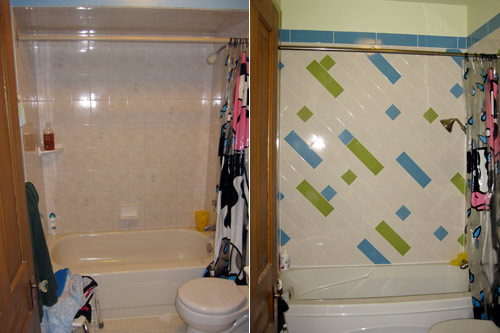
Old vs. new bathroom
Old vs. new bathroom. Bath curtain hasn’t changed.

Bathtub

How to get Jon in and out of the bathtub easily was a major discussion point. Up until now it was a two-attendent job: Peter to hold Jon upright; me to help Jon step onto the bathtub rim and then into the tub. Getting him out was even more challenging, and required a move from Peter and (now slippery) Jon that resembled something out of Cirque du Soleil—I was there to make sure the bench was in place to catch Jon! Dangerous and required a lot of muscle: if Peter went out for an evening, Jon didn’t get a bath. The occupational therapist from Bloorview suggested several options:

Electric ceiling lift (basically a bosun’s chair suspended from the ceiling)
Pros: Effective lifting
Cons: Overkill for Jon; makes house look like a hospital
We nixed this one right away.

Walk-in bathtub
Pros: Easy to step into; can be quite stylish
Cons: Hideously expensive (~$4000 and way, way up); can’t take showers in tub
We finally rejected this one because the shorter tub size was an awkward fit for our bathroom (too short to fit without bulkheads; too big to fit both it and a shower area). More critically, it would still be hard to get Jon in and out of the tub single-handedly, and the danger of him slipping would still be high.

Electric bathchair lift
Pros: Portable; no structural changes needed
Cons: Expensive (~$1700); impermanent—we would have to move it (and store it) every time Jon had a bath

Roll-in shower
Pros: Not expensive (since we were ripping out original tub anyway)
Cons: No baths for anyone; Jon dislikes showers
Since Jon doesn’t use a wheelchair on the second floor, we decided there wasn’t much point to this.

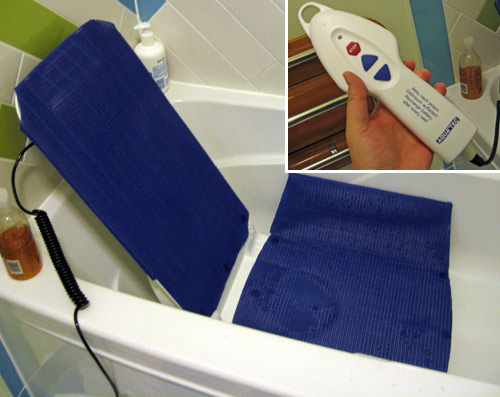
After a lot of discussion and cogitation, we settled on the bathchair lift. At worst it would be an interim solution until Jon finally stops growing and we can make a more permanent decision. We had one demoed for us by Jon’s wheelchair supplier, HME. Other than the bulky rechargeable batteries hanging off the back (which made it look jury-rigged) it seemed satisfactory. When the lift was delivered, however, the technology had improved to having the batteries set in the relatively small remote—a much more elegant solution. And as it turned out, Jon loves his bath chair—I guess we shouldn’t have been surprised, since Jon is endlessly fascinated by elevators and platform lifts. As for storage, we air-dry the two pieces on a towel overnight and then store it under Jon’s bed, easy-peasy. So it’s working out just fine!

Bathlift
Bathchair lift. Inset: Remote containing batteries.

Toilet grab bars

Another major issue was what kind of grab bars we should have surrounding the toilet. Grab bars would make it easier for Jon to reposition himself on the pot as well as helps transfers to and from the toilet. The options we were looking at were rails that attached to and stick out from the toilet bowl, and ones mounted on the wall that flip down for use. Flip-down bars sounded more attractive to us, but the space between toilet and tub was so small that there likely wasn’t enough room for the wall plate.

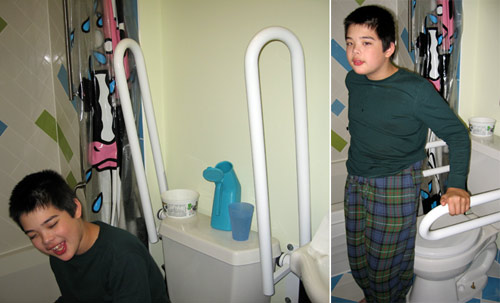
Then miracle worker Mike told us that since the floor and subfloor were getting replaced (in preparation for ceramic tiles) and things were getting rejigged, he could move the toilet away from the tub a couple of inches—enough to fit the wall bars. Yay! It was a very tight squeeze, and for a moment during installation it was pretty scary (the vendor had given us an incorrect measurement), but they finally did fit and work just dandy. When Jon tried the grab bars out for the first time we asked him to get up, and holding the bars he launched himself to standing with no hesitation!

Jon with new grab bars
Toilet bars up; Jon standing with bars down.

Faucets and taps

We chose a faucet set with a nice brushed nickel finish, and discovered—naturally—that if you wanted a moveable shower head attachment (showerhead, hose, vertical support rod) in brushed nickel rather than the usual, institutional chrome, it would jack up the price by about 200%. (Admittedly we may have been comparing apples and oranges since a lot of the chrome pieces looked decidedly chintzy and off-brand, whereas the brushed nickel attachments were name-brand, attractive and sturdy.)

Bath bench

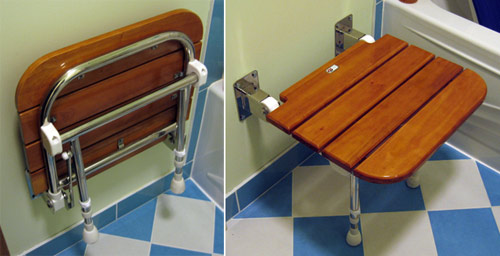
We knew we probably needed to keep some sort of bench for Jon to sit on after his bath. When we were checking out walk-in tubs at a local accessibility products store we came across a wall-mounted wooden fold-up bench that would let us ditch the ugly, flimsy bench we already had. It was a bit more expensive than we were hoping for (so what else is new?), but after a few weeks of use we’ve found it worth the money—incredibly useful for everyone in the family; not just Jon.

chair up and down
Bench folded up and down.

Vanity and sink

The occupational therapist had suggested that the sink be relatively tall, with an overhanging basin, to make it easier for Jon to either a) roll under the sink or b) stand up at the sink. So we got a basin that sticks out about 6 inches from a vanity cabinet, and raised the works about 4 inches by putting it on a platform. However, we realized too late that Jon was helping himself stand at the old sink by jamming his knees against the cabinet doors. The new vanity’s doors are set too far in for him to stand effectively this way, as well as too flimsy to withstand that kind of abuse. So we’re discouraging Jon from bracing his knees this way, and therefore he’s finding it very difficult to stand straight at the sink. So the jury’s still out regarding how well the new sink and Jon work together. We’re hoping the sink-side grab bars we’re installing will help.

Tiling

We had picked a family of tiles at Olympia Tile. We suggested a checkerboard pattern for the floor, but basically gave Mike (tiler extraordinaire) carte blanche to figure out what to do with the tub surround, which he did brilliantly (for example, I never would’ve thought of laying tiles on the wall diagonally). Our one bit of decadence: in-floor heating—no more cold tootsies on freezing winter nights!

Yet to come

Mirrored medicine cabinet (to be inset into the wall); more grab bars. Can’t wait!