Jon, when self-motivated, can do his spelling list (typing the 10 words three times each) in about 3 minutes. Sometimes however, he malingers for upwards of 40 minutes, grumbling and whiny. Then there are days like this: he more or less gets down to work, but under protest.
I laughed out loud then ran for the camera. He had erased a couple of the commas by the time I got back, but you can see the sneaky grin.
Also, lately, any time either Laura and I make an exclamation (ie Damn!, I don’t believe it!, What the…?), Jon immediately says, “What is it?” and wants to know what the problem is. Doesn’t always understand the explanation, but he suddenly wants know everything that’s going on. Very nice.
There is a fascinating article at wired.com about how scientists are rethinking previously-held beliefs about autism. Previously it was universally held that a large majority of autistic people were mentally deficient: 75% of autistics were expected to show an IQ of 70 or less on a standard intelligence test.
Now, led by some maverick neuropsychological researchers as well as some politically-and tech-savvy autistics themselves, a growing movement is putting forth the radical notion that autism not be looked at as a disease to be eradicated; rather, autistic brains should be looked at as simply a different form of human development.
A video circulating the internet is at the forefront of this new belief. It shows a young, obviously autistic woman gesturing, flapping, moaning and rocking—looking every inch the low-functioning autistic. Then a computerized voice starts talking and you quickly realize that it’s the woman herself—she can’t speak, but she can type (extremely fast) and communicate via computer. She proceeds to explain—with eloquence and insight—what’s going through her mind while she’s doing these motions: This is her way of experiencing the world, and it’s as natural and normal to her as looking at things is normal for everyone else. She doesn’t need a cure; she wants respect.
Amanda Biggs’s “In My Language” video
One of the major planks in the new movement is growing evidence that the Wechsler Adult Intelligence Scale, the standard IQ test used to determine autistics’ level of functioning, is inadequate for doing this. It races the clock, and generally measures language, social interaction, and cultural knowledge, which most autistics score poorly at. In contrast, the Raven Progressive Matrices test, which is not time-based, more accurately scores for abstract reasoning, pattern spotting or puzzle-solving. In one recent test involving 51 autistic and 43 non-autistic people the difference in IQ between the two tests for the autistics averaged about 30 points (non-autistics showed no differences between the tests). Stunningly, using Raven pulled all but a couple of the children out of the “mental retardation” range found by Wechsler, and sent one child from “mentally retarded” to the 94th percentile.
So why is an inadequate test still being used? Because people are used to administering it. Digression: This is not surprising to me; every institution suffers in some way or another from inertia—doing things one way because it’s always been done. In one of Jon’s earlier years at school his teacher kept trying to teach him sign language, because it had worked for previous kids in her care. We kept reminding her that since Jon is visually-impaired he would hardly benefit from it, but it never seemed to stick.
The new model of autism has its adherents, but others are skeptical. They argue that even if some autistics are more intelligent than previously believed many are still profoundly disabled and would benefit from a cure if there was ever one to be had. And indeed, when you hear stories about autistics damaging themselves and all but destroying their families’ spirit or homes one might have a hard time agreeing that all autistic behaviour is somehow “empowering” or benign.
Yesterday we had a Lockdown Drill. It happened right after lunch. I was on my way to the Adventure Centre to play. We had to go to the closest area. We went to the religion room until the principal made an announcement and said that the Lockdown Drill was over. I had a great day at school.
VIDEO PREVIEW SECTION
Tonight I’m going to watch Save The Chimp episode of The Wonder Pets.
I went to chelsea in Ottawa. At chelsea they don’t have the weather Network. They just have CBC channels. I went lugeing. Paul watched the movie Ratatouille. But Jaimy and Willa didn’t watch a short it is called Lifted. I like to have some dinner. After dinner I watched a DVD. The DVD I was watching at chelsea is The Wonder Pets.
VIDEO PREVIEW SECTION
Tonight I’m going to watch save the dragon episode of Wonder Pets. The dragon is from a madgical land.
On Sunday we had visiters who stayed for dinner. Susan and Ian broght Igby over. Igby’s fur is black and a little bit white. She is the same size as Photon. She has lots of fur and it’s very soft. I enjoyed petting her and she played with Photon too. Susan and Ian stayed for a long time. I enjoyed having them over. I hope they come over again soon.
VIDEO PREVIEW SECTION
After supper I watched The Wonder Pets. I saw save the owl episode. It was fun to watch.
(Igby is actually a Yorkshire terrier, so he’s brown, tiny and not so soft. But he and Photon definitely did play a lot. Because Jon’s journals always had these video non sequiturs at the end, we suggested he do a separate little bit about this after the main journal entry. Hence the “video preview section”. —L)
This video has been circulating the web for a while now, but I just rediscovered it. Johnny Lee, a PhD student at Carnegie Mellon, has developed a nifty 3D virtual reality setup that uses a Wii remote and sensor bar.
At Lee’s website he demonstrates other clever uses of the Wii, including a nice interactive whiteboard.
 Jon, when self-motivated, can do his spelling list (typing the 10 words three times each) in about 3 minutes. Sometimes however, he malingers for upwards of 40 minutes, grumbling and whiny. Then there are days like this: he more or less gets down to work, but under protest.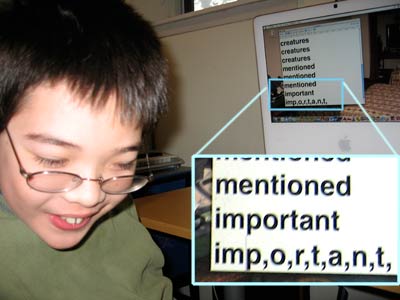
 There is a
  Feb. 28/08