Polly wants a polka

Laura (Title stolen from Quirks and Quarks radio segment) Can animals (other than humans) move to a beat? Do those dancing dogs (1) (2) really feel the rhythm? As far as the dogs are concerned, probably not (and not without a ton of training). However two recent studies suggest that parrots and some other birds can. One bird, Snowball the cockatoo, can demonstrably shift his dancing rhythm as the tempo changes:


Dancing Snowball


Bird really Shaking his Tail Feather

The researchers theorize that the only animals other than people who can dance to a rhythm are animals with brain systems capable of vocal learning. One group, at Harvard University, searched thousands of YouTube videos (nice work if you can get it!) for dancing animals and found that only birds who could imitate sound seemed to have any rhythm at all. A few elephants show rhythm as well, and apparently elephants also have vocal mimicry ability. The researchers are interested to find out whether dolphins (with their high level of vocal mimicry skills) also possess rhythm.

So another “human-only” ability (after tool-making) may be about to fall to the wayside…
3-D

Laura Yeah, yeah, I know, it’s been a looooong time since we’ve posted anything to this site. There will be spotty posting for the next week or so as two thirds of PLJ juggle a killer work deadline (while the other third will enjoy the Weather Network while decapitating his chocolate bunny…)

A couple of weeks back we saw Coraline, which was quite enjoyable: Amazing stop-motion animation and a story that didn’t fall apart in the third act like some of Henry Selick’s previous movies. The only irritating thing for me (and only a little bit irritating—we’re talking vague itch and not a real pain in the neck) was that the movie was in 3-D and we had to wear those goofy glasses.

3-D, far from being the amazing new innovation in movies is simply a rehash of the old movie 3-D technology in digital form. What was surprising to me when I looked it up was that the new system is not much different than the old one; contrary to myth, the old movies never used red and blue lenses, but used a polarized system much like the current one. Red and blue lenses were actually popularized by 3-D comic books.

When the whole family saw Bolt in 3-D a few months back, I was relieved to find that the two-thirds of PLJ who can’t see stereoscopically didn’t find the glasses too annoying (though obviously getting no benefit from the technology. And still having to pay the premium price. And wear the extra pair of glasses.) The sad thing is that when Pixar’s next, Up, rolls out, I’m betting that it will be hard to find a decent (big, digital, good sound) screen in T.O. showing it in good ol’ 2-D.

Speaking as one of the stereoscopically-challenged, here’s hoping 3-D’s a fad.

Whither the Wild Things

Laura Okay, I have to admit when I first heard that they were making a movie version of Maurice Sendak’s picture book Where the Wild Things Are, I winced. I assumed it would be yet another case of a beloved (and short) kid’s classic being turned into a windy, big-budget, embarrassing cringefest (cf. The Cat in the Hat).

Well, Where the Wild Things Are still could be not good. But I perked up a bit when I heard that the director was Spike Jonze, director of a couple of the most interesting (read: totally wigged out, but in a good way) movies I’ve ever seen: Adaptation and Being John Malkovich. Once I saw the trailer, I’m even more hopeful. It’s a wonderful trailer — I’m keeping my fingers crossed that it’ll be a wonderful movie.

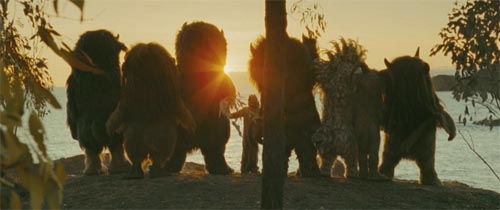
Max and the wild things howling
Max and his wild things howling in the sunset

In Winged-Yet-Hairy Exploration News

SpaceBat on the fuel tank

Peter In case you missed it, as somehow I did, shortly before the shuttle Discovery’s launch last week (Misson STS-119, if you’ve scoring on your programme at home), a free tail bat latched on to its external fuel tank, in what to can only be surmised to be an obvious attempt to cut the line in the stringent astronaut selection process. In a way, he did become officially recognized, as his callsign became Interim Problem Report 119V-0080.

Unlike previous bat-attempted stowaways, this one had the guts to stay latched on to the tank through the igniting of the engines and lift-off of the rocket (it may have had something to do with it’s broken left wing and an injured right shoulder or wrist that naturalists noted before the launch). The point is, our mammalian counterpart does have a helluva lot more flying hours under his belt than any of us, and officials do know that he cleared the tower.

From here, we’ll quote the Globe’s Nerd Girl, Dr. Jennifer Gardy:

While in my heart of hearts I had hoped that SpaceBat at least made it out of the troposphere…the reality of the shuttle launch is that he probably only held on for a few seconds past the tower before he lost his grip. After a mere moment of free-fall, little IPR 119V-0080 would have tumbled into the solid rocket booster’s exhaust plume and expired in a blazing hot trail of spent rocket fuel.

As my shuttle-savvy friend bluntly put it, “In all probability, Squeaky McSpaceBat’s body was charred to almost beyond recognition, then swept up with all the rest of the miscellaneous debris that falls on the pad post-launch. But it’s way cooler if he made it to space, so I’m going with that.” Link

We’ll leave you with this, somewhat sentimental and definitely not necessarily accurate, YouTube tribute video:

And then this documdrama. While not entirely accurate, it is based on a true story, which means it’s way more accurate than any horror movie that has used that tagline…

Nodal Point

Peter Here’s an interesting little essay about the state of the newspaper world and how the internet is causing major upheavals. It explores various aspects of the crisis, even as North America is suddenly starting to lose some big, established newspapers.

There are some wonderful comparisons with the point in history just after the printing press was introduced, and the immediate societal effects (hint: chaos). New paradigms don’t spring forth fully-fledged, and old ones tend to fall before the new are established.

Historically, newspapers were the most practical way to deliver journalism—that’s the commodity. To defend the printed newsprint itself against a delivery system that is simply more efficient is missing the point of what is happening.

It reminds me of William Gibson’s Bridge Trilogy, specifically All Tomorrow’s Parties, when he speaks of “nodal points” in history: when events and technology come together to change the path of society in some way. The major players of the current day can’t prevent the change; in the end, the new way of working/thinking will likely win out. The question is whether the old players will be left behind, or adapt to the change and somehow retain some measure of their former stature.