 If you’ve been wondering why we haven’t posted in awhile, much of the reason is contained in this post. Over the last few months we’ve been going through the rather difficult process of finding a suitable high school for Jon, and it’s taken up more of our time and energy than you’d think.
Part 1: The Adventure Begins
The process started late October, when all of the graduating kids’ parents attended a meeting with the school board rep in charge of transitioning special ed students to high school. All the parents were apprehensive and nervous; you never saw such a grim-looking bunch of people in your life! The board rep cheerily assured us that by early spring each student would be getting a list of “two or three” local schools, which parents could check out before making a decision.
Fast-forward to May (so much for early spring), and we still hadn’t heard anything yet. Getting antsy, we pestered our Vice-Principal for info. Apparently one of our sector’s* schools had shut down its program for developmental delayed (DD) students and the board was scrambling to place the kids into other schools before worrying about the new intakes. This did not help our apprehension about the system: Either the board knew of the closure for some time and should have placed these students a while back; or it was a total shock for everyone, which doesn’t bode well about the permanence of any of these programs.
Part 2: Monarch Park
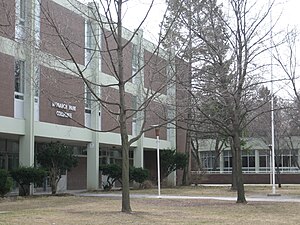 PLJ visited our first school, Monarch Park Collegiate Institute, in mid-May. Accompanying us was Jon’s current teacher, Denis. Having a teacher along for the look-see was a huge relief to us, since he would catch things that we parents might miss.
The head of the Monarch Park DD program took us around the school. He was cheerful and enthusiastic (in a bluff, hail fellow well met sort of way). Monarch Park’s facilities—gym, pool—were a little worn (the school was built in the 1960s), but quite decent and, on the whole, entirely satisfactory. The whole DD program consists of about 40 kids in four classrooms. Jon’s potential homeroom contained the kids in wheelchairs; the other classes are more mobile. Staffing levels likewise were satisfactory—in Jon’s potential class there was a teacher and two EAs for 10 students.
The satisfaction came to a screeching halt when we actually saw the classrooms and listened to the head’s spiel about the DD program. (The head would also be Jon’s teacher if we picked this school.) His classroom was tiny—or did it just seem that way because it was so crammed? What limited space was dominated by a phalanx of worktables, where the students were diligently painting pieces of wood. There seemed barely enough room for the five kids in wheelchairs to wheel around (and that was only half of the class of 10). The students’ computers were jammed in together along the back wall, and we were all doing mental gymnastics contemplating how Jon’s wheelchair, computer, CCTV and stander could possibly fit.
The Monarch Park DD program proudly bills itself as a work-preparedness program, prepping developmentally-delayed students for the workforce. The students’ math lessons largely involve practical numeracy, focusing mainly on time and money calculations. Students learn social interaction and how to handle money by selling baked goods or delivering newspapers around the school. The classes create wooden plaques for awards or picture frames that are sold at a profit to other schools. They also grow plants and press paper for hand-made greeting cards, which are likewise sold. We leafed through examples of the cards (attractive, with pressed flowers), while the teacher boasted about the time a School Board head honcho ordered 60 cards, so the kids had to drop everything and produce cards in a hurry to get them done in two days!
We started to get an uncomfortable feeling during these spiels. Workplace readiness is great, but the program was so workplace-focused that it seemed to us that individualized academics were being given short shrift. (After all, something had to give way during cranking out those damn cards!) Visions of child labour sweatshops danced creepily in our brains. Denis did his best to remain neutral—since the ultimate decision is not his to make—but it was pretty evident that he was not impressed with the program.
After much consideration, we finally had to ask ourselves, “how would Jon do in this program?”, and the answer we came up with was “Not great.” Jon loves his academics, his spelling, his journal writing, even his arithmetic: Frankly, he’s a DD nerd! And he’s never been overly crazy about doing crafts-y stuff—due to his motor and visual difficulties. He’ll never complain, but he doesn’t get much out of it.
We asked Sunny View’s Vice-Principal for another school, so we could compare programs. (I’m using the royal “we” here; I was so stressed after the visit I came down with a migraine and couldn’t talk on the phone.) She kept asking whether this meant we were rejecting the school. We had to clearly state that no, we weren’t rejecting anything; we just wanted to see what else was available first before we made a decision. The Toronto School Board, it turns out, isn’t too keen on choice. Finally, two weeks later (in June), we got the name of a second school.
Part 3: Danforth Tech
 If Monarch Park was a little frayed around the edges, Danforth Collegiate and Technical Institute looked scarily like something out of a Victorian novel (though in actuality built in 1922). Huge, towering hallways with massive stonework doorways, worn-looking paint jobs in drab colours, battered lockers and walls, years of spit and polish not quite covering up the grime of time. This was not helped by us getting lost in the industrial maze of the basement level. We were rescued by a friendly custodian, who took us to the main office via a tiny, weathered elevator. The rest of the facilities were just as shabby: Obviously no pool; it was unclear to us how much gym access wheelchair-bound students would have. That one little elevator seemed to be the limit of accessibility for the whole school. This wasn’t starting well.
Our guide was a guidance counsellor and one of the heads of the special ed programs at the school. She was very friendly; and we noted with satisfaction that when we met the teachers she always introduced Jon first, got Peter and my last names right, and introduced Denis (none of which the Monarch Park program head had managed to do.)
The DD program was in the (rather ugly) basement of the school. Slightly fewer numbers of kids than Monarch Park, but only one or two wheelchair students. Jon would definitely be a minority within a minority at school. Because most of the students are not physically disabled, there is only one EA for the teacher and 10 students. The wheelchair ramp from outside was off in a corner of one of the classrooms—if Jon came in late to school from a dentist appointment he’d have to pass through that room to get to his class—not an ideal setup. For field trips Jon will likely have to take Wheeltrans, since the low numbers of wheelchair students would preclude getting a dedicated wheelchair bus. Grumble.
However…
Once we got to Jon’s potential classroom and started talking with the teacher, we started breathing easier. The room was set up much like Jon’s current class, with lots of space for moving around from table to desk to computer, which the kids seemed to do often. Plenty of room for Jon’s equipment. Teaching is individually tailored for each student, and focused on schoolwork (no North-Pole elves’ plaque-making here!) The teacher was dynamic and positive, and she seemed to be on the same plane as Denis (whom we consider to have a proven formula with Jon).
Part 4: Decision Time
After taking Jon back to Sunny View and talking with Denis, it was good to see that we were all in agreement that this program was far better for Jon. To assuage our parental “but-are-we-absolutely-sure?” jitters we finally asked “are we likely to find a better program for Jon at another school?”—to which, after some thought, the answer was “no, probably not.” That was good enough for us. Come September this year, Jon will be a high schooler attending Danforth Tech.
* The Toronto District School Board divides the area up into several geographic sectors. Somehow we are considered part of the South-West quadrant, which is amusing to anyone living east of the Don River, but that pretty much tells you all you need to know about the TDSB.

 Yes, it’s a very sturdy, orthopaedic stander. It will help stretch Jon’s hamstrings and hopefully inhibit further progress of his scoliosis. Jon did some standing in class this past year, and it turns out he’d prefer to stand and learn than sit. It was especially effective for teaching math, and we walked into a class where Jon’s teacher Denis was basically giving Jon the “stand and deliver” treatment. The whole class was involved, but if any of the other students were having trouble, Jon was called in to suggest assistance. Wow.


