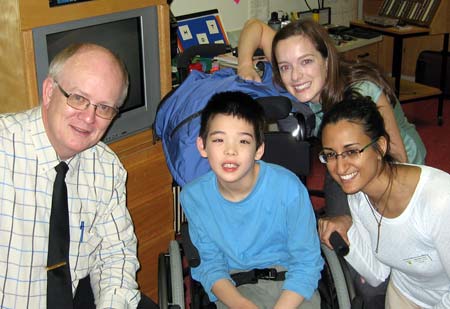
 Jon has met a lot of doctors in his time, and some of them are quite amazing people. Dr. Pam at Sick Kids was one. Dr. Rick Wiggins, an optometry professor at the Special-Needs Eye Clinic at the University of Waterloo, is another. He’s a great doctor and an amazing teacher. Each visit, he is teaching a team of two interns, who conduct the initial examination and it’s almost worth it to watch him teach them, aside from the fact that he’s also teaching us and watching Jon and catching details that even we as parents have missed.
The way the Waterloo eye clinic deals with special needs kids is, in our experience, so different from the far more clinical approach of other doctors. For instance, Jon came out of a rigorous eye exam, but all he could talk about afterwards was that he had watched Finding Nemo. After some vision tests with projectors and cards, they study the internal eye stuff by letting the kid watch TV while they examine the lens from a bit of a distance (no drops, either!). Dr. Wiggins, ever attuned to the patient, picked up on Jon’s interest in Pixar, so that’s what was on the VCR when it came time to watch.
Despite the fact that these trips to Waterloo pretty much take out the entire day, we’ve always seen it as a fun adventure. We always come out of it fully briefed, with proactive ideas and expert advice about what we can do next. Our kid comes out happy as a clam, no worse for wear after an hour-long exam of his weakest sensory system.
And we get to eat at Swiss Chalet for lunch, another tradition, which makes Jon even happier.
So how did it go? His eyes are healthy. We’re getting a clearer idea of how Jon sees. While most humans would have commited to one strong eye by his age (thus ending up with one “lazy” one), Jon uses both of his eyes independently. Generally together, but if he needs detail, he’ll in-turn the unused eye to keep things sharp. Anyway, given that he’s still using both eyes at almost age 10, we can expect that he’s got them for life.
A brief primer on how you see: when you look at things, your eyes are moving in tiny saccades, jumping around both to study detail and to keep the retinal image fresh. Jon’s eyes move in saccades too, but his jumps are less fine. As well, his eyes undergo nystagmus (involuntary rapid, rhythmic eye movements). This would especially affect things like reading. Questions for the future: will his eye tracking improve as his reading does? Or is this another of his motor issues, and may limit future progress in reading? We can only push the envelope and find out.
Over the years, we’ve had to explain to many, many people that this is something glasses can’t fix. The trouble is deep in his visual cortex, the part of your brain that takes the what the electrical signals sent by the eye and decodes it into something you “see”. So it has nothing to do with his eyes. And that’s final.
Oh, by the way, Jon needs glasses.
Yep, he’s taking after Mom and Dad, and is a little near-sighted! As we say, this isn’t to help the CVI, but just the everyday focusing.
With Jon, as always, it’s a little more interesting. Dr Wiggins points out that given all of the cortical issues, whether or not Jon ends up wearing the glasses will be based on performance. If they improve things noticably for him, he’ll likely fight to keep them. If they aren’t working for him, or keeps taking them off for whatever reason, they are of no use and we will not force the issue. His unique view of the world is the arbiter. And if they don’t take now, they may later.

And then there were twelve (eyes in the household).