 Anyone who’s taken psychology brain-and-behaviour courses has probably come across the gruesome case of Phineas Gage. In 1848, Gage, a 25-year-old Vermont railroad worker, was using a three-foot tamping iron to pack blasting powder in rock. The powder prematurely ignited, sending the 13-pound iron firing up into his cheek and through his brain, exiting from his frontal cortex. (See an animated illustration here.) Gage not only survived this horrifying accident, but was lucid and chatty on the way to the hospital, and his normalcy was later exhibited to amazed doctors. He died 11 years later.
The standard trope was then that Gage immediately started to show unpleasant personality changes due to his brain damage. The psych textbooks seemed to revel in Gage’s bad behaviour, pointing out how he became quarrelsome, alcoholic, neglectful of his appearance, choleric and unemployable. Interestingly, there is now controversy over whether these personality changes actually were as severe as has been quoted in textbooks. Certainly the fact that he managed to travel extensively and hold down jobs, one of them driving long-distance stagecoaches, suggests that if he did have personality changes they were not long-lasting or severe in nature.
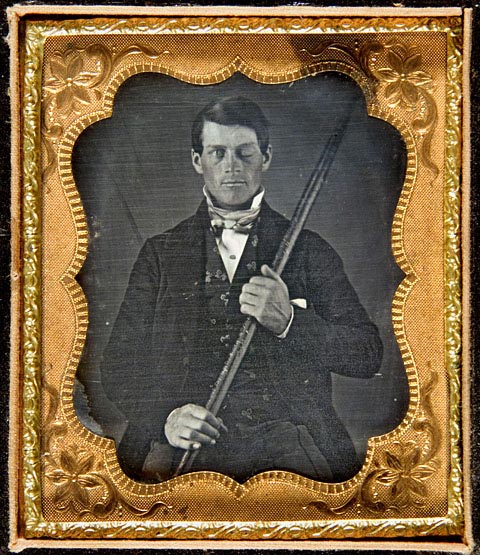
Daguerreotype from the collection of Jack and Beverly Wilgus
In 2007 Jack and Beverly Wilgus, a couple from Maryland, posted on Flickr a favourite photo that they had owned for several decades. It was a daguerreotype from the mid-1800s showing a dapper gent missing an eye, and posing with an odd, pointed object. They posited that the gent was an injured whaler with his harpoon, but were quickly disabused of that notion by commenters. The name Phineas Gage kept coming up, and intrigued, the Wilguses compared the photo to pictures of a lifecast made of Gage:
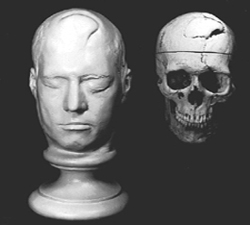
Lifemask (often incorrectly referred to as a deathmask) and skull of Gage
The pictures matched up perfectly, and if that weren’t enough evidence, on the object in their photo you could read part of the inscription that was known to be written on Gage’s actual tamping iron, “This is the bar that was shot through the head of Mr. Phineas P. Gage.” (Wilgus’s Phineas Gage website)
Though it’s hard to tell personality from a vintage photo—where people had to hold their pose for many seconds—one would like to think that this hale, assured-looking young man was not the profane wastral that he has been painted as through history.
Researchers such as Malcolm Macmillan and I hope readers can contribute to a fuller picture of Phineas Gage by helping answer questions such as those below. Many relate not to Gage directly, but rather to people he met or places he’d been. FOR MORE SPECIFIC QUESTIONS, and how the answers might help us better understand Phineas, please visit http://www.deakin.edu.au/hmnbs/psychology/gagepage/PgQuestn.php .
Information might be in letters and diaries; medical and business records; town, police and court files; local newspapers; or in the archives of churches, hospitals and literary, professional, historical and genealogical societies. We especially hope organizations will search their one-of-a-kind materials not published in book form.
IN CHILE (1852-60): We want to know about Drs. William and Henry Trevitt, Masonic lodges, Methodist churches, and English-language newspapers, schools and businesses. Do you know anyone who can help with such things?
IN NEW ENGLAND (1848-54): Can you find newspaper or diary accounts of Phineas’ accident, of his travels exhibiting himself and his “iron,†or of his reported preaching at Methodist revivals in Sterling, Mass.? In Concord, NH records of the Abbot-Downing coachworks could identify “three enterprising New Englanders†who may have set up the coach line for which Phineas drove in Chile; in Hanover you might discover Phineas’ duties at Currier’s Inn, or a Dartmouth professor who met him; and somewhere in Wilton may be the papers of Henry Trevitt.
IN CALIFORNIA (1860- ): Where is the missing undertaker’s ledger showing where Gage died? What can you discover about Dr. William Jackson Wentworth (Alameda Co.) or the papers of Joseph Stalder (d.1931)? Are you descended from Phineas’s nieces/nephew Hannah, Delia, Mary, Alice, or Frank B.Shattuck? Can we learn more about Frank at the School for the Deaf?
IN OHIO (1860- ): Can you find anything about Henry Trevitt’s time at Starling Medical College in Columbus, Prof. J.W. Hamilton, or William Trevitt’s papers?
ANYWHERE: If you are related to the Cowdrey, Davis, Ames, or Kimball families, are you also related to Phineas’ doctor, John Martyn Harlow? Do you know of ship passenger lists (Boston, New York, Chile, Panama, S.F.) that might show Gage family movements? Do you have Gold Rush ancestors who stopped in Valparaiso, Chile? And of course, letters mentioning Gage could have gone anywhere.
There are more clues in Stillwater and Northfield, MN; Santa Clara, San Rafael, and S.F., CA; Cavendish, Castleton, Woodstock, and Burlington, VT; Lebanon and Enfield, NH; Albany, NY, Buda, IL, the National Library of Medicine, and other places. At http://www.deakin.edu.au/hmnbs/psychology/gagepage/PgQuestn.php are details on how you can help by following such clues. Your help or inquiries to malcolm.macmillan@unimelb.edu.au will be very much appreciated.
We would be pleased to assist teachers (in New England, S.F., even Chile?) in creating a class project involving students’ search for family papers or local lore about Gage.
Matthew’s project sounds so cool that if I had any info on Gage, I would surely participate. The amount of data they’ve already amassed at Deakin is amazing. Best of luck.