The Techniques We Do Nightly as of April 2005
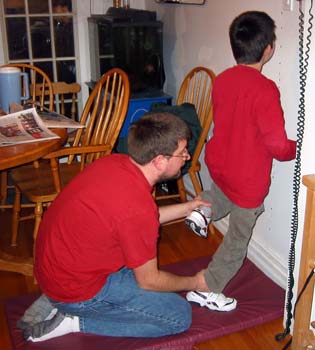
#1: Wall
Warm up with 100 steps at the wall. Jon simply leans slightly on the wall, and lifts and steps with his legs. I’m there to guide, and help a little. On a good night: 2 minutes, on a bad night 5 minutes.
 If you’ve ever called the house around 7 in the evening, Laura has answered, and if you asked for me you were told that I’ll call back. It’s MEDEK time in the house.
Jon and I have been doing physiotherapy daily at home for over 7 years now. MEDEK is a Spanish anagram that translates as Dynamic Method of Kinetic Stimulation. The therapy was developed by a Chilean therapist for kids with neurological issues. The idea was to get them to use any muscles they have at their disposal by isolating those muscle groups. And do the exercises regularly.
It’s not for every kid – when they are young there are some moves involving suspending the kid in certain positions in mid-air (isolating which muscles they can use) – and that can terrify some. And some kids just can’t do the motions, so the program is not for them. And not every parent can stand the regularity or firmness required.
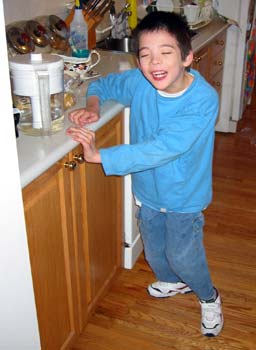
Technique #2: Counter
Ideally not shimmying along, but walking facing the direction he’s headed in, using the counter for stability.
This has led to controversy. Some doctors who haven’t seen it have a kneejerk denial towards it, since there’s a lot of pseudoscience bandied about in the circles of young parents with new disabled kids. This isn’t helped by the fact that since it isn’t covered by Ontario’s health system, it is offered as an “alternative therapy” lumping it in with all the quackery, despite the fact that the practitioners are traditionally-educated, university-accredited physiotherapists.
Jon’s neurologist, always on the watch for questionable science (and willing to share the gossip with us) is a big fan of MEDEK, based solely on the end results she sees in her patients. Laura and I approach it simply looking at the fundamentals; it is structured physio. The first technique that involves dipping him in olive oil and rolling him in sesame seeds is when we’re out of there.
Jon’s therapist is Ester Fink, the woman who brought it to Canada. She’s this tiny lady who – from what I’ve seen in the lifting department – must swing bags of cement for exercise. As she works she reminds me of my Aikido Sensei Kimeda: they both have a learned sense of just how the human body moves and what touch can motivate or stop a movement.
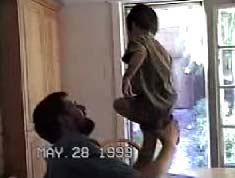
I can’t do this anymore
One of the earliest techniques, now fully developed and extended. Six years later, he’s waaaay too heavy.Click picture for a QuickTime movie.
Each exercise is put into a context where the required movement should be obvious; not necessarily easy. At each session you are given a number of techniques to work on at home. They recommend doing it twice a day, which we did until public school started and the morning shift had to go. It’s intense and can be brusque, but in no way abusive. The kid is allowed to cry/bawl/scream as they do their work; as Ester says, we don’t collapse in a heap when we cry.
Jon, for one, cried relentlessly, session after session, for about a year straight. But at the end of each session, he would immediately stop, content and untraumatized, and always looked forward to going to “Ester’s House” the next week.
Contrast this with the physio that is standard in institutions like the local hospital serving disabled kids, where you have a weekly-at-best session featuring some beside-manner chit-chat, and a few techniques and encouragement, rather sing-songy. No intensity.
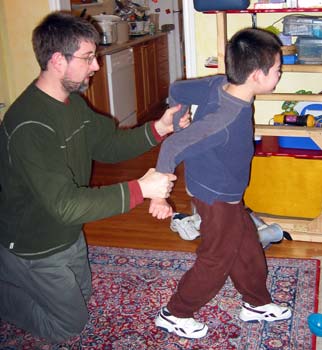
Technique #3: Stepping with Arms
Optional, since the next technique requires most of the skills used here, but sometimes it’s good to warm up with him stepping while I pull on his arms to make him resist and get him upright.
At Jon’s last hip examination, a young hospital physiotherapist told me that he didn’t think that MEDEK was adequate. I told him “great, give me some other techniques, I’d love to add them to the nightly repertoire,” and he was taken aback. All he could think of was a standard leg lift, and he couldn’t figure out how to apply that to Jon’s abilities. Then he just got sullen and made up excuses. Bah.
Over the past few years, more of the institutional therapists we bump into have taken MEDEK courses, to at least adapt parts of the therapy into their own techniques. This sort of cross-pollination is ideal.
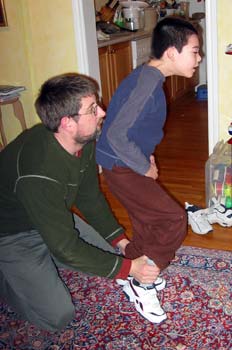
Technique #4: Ankle-stepping
Our core technique now. I hold his ankles and help him step. Jon is responsible for some of the stepping, and holding the rest of his body up. 10-15 repetitions.
The MEDEK side will have to learn it too. The practitioners are dead-set against some standard practices – braces, walkers and most surgery, on more-or-less ideological grounds. You can understand the logic – the MEDEK activity can create very real change physiological changes that, for some kids, would mean surgery was unnecessary. But in Jon’s case, his right socket had not formed fully and the surgery re-established the joint. Same for the braces (Ankle-Foot Orthotics) that many kids, including Jon, wear to school (it helps them keep their Achilles tendon stretched). Ideally the kid would be crawling around and climbing – situations where the AFOs may not as appropriate. However, in school these kids are in wheelchairs all day, and correcting the leg goes a long way to keeping the Achilles tendon stretched and correcting overall posture. So it must be.
Then again, it shocks some of our doctors and therapists to know that Jon casts off the AFO’s at home, but they forget that he’s out of his wheelchair here – a man on the move, crawling and climbing and standing in his stander. And they are impressed at how his ankles have not tightened or atrophied.
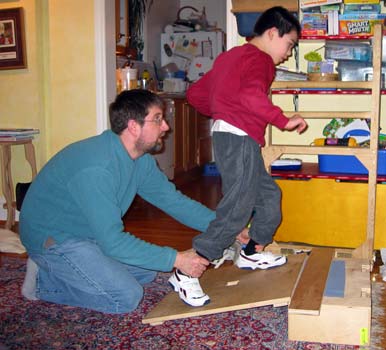
Technique #5: Ankle-stepping Up Ramp (Optional)
If #4 was fluid, we’ll head up the ramp. Up to a year ago this was standard, but now Jon is too tall and heavy to do this with if he’s unsteady. 5-10 repetitions. We used to do a reverse version of this called Down-Ramp, which required Laura’s help too, but he’s too big for Laura to catch safely if he pitches.
There is no one answer. Laura and I cherry-pick with great care, not for convenience, but for firm results for the time invested. As in so many things, Jon has shown so much willpower and strength beyond anyone’s predications, and we can only hope to live up to it.
We haven’t seen Ester is quite a while, maybe two years. About three years ago Jon stopped showing much progress. He wasn’t regressing, but he couldn’t seem to make the neurological patterns to make the next cognitive jump. Ester admitted that it perplexed her, he’s such a unique case. (We hear that about Jon from almost every professional that gets to know him) She suggested we keep working on it and return when he’s improved. Well, we’ve been working on the same exercises ever since, but I don’t think we’ll ever make it back. Poor Jon has been growing like a weed, and his centre of mass is ever taller. But the constant work has meant there’s been no slipping back, and he holds himself tall. It has kept him in shape to use his walker at school, his bike at home and his stander.
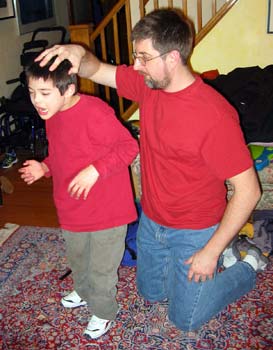
Technique #6: Hand On Head
I push on his head and he stands up straight to resist it. This never used to work when we were attending sessions, but now Jon has taken to it. He has the patience for a count of up to 30, but we once got up to 60 (I confused him by counting down). By the way, he’s yelling something quite cheerfully, he’s not in any pain.
An impolitic therapist admired the work I had put into it with Jon about a year ago, then turned on me and said prophetically, “It won’t do any good in the end. His back will still curve, his posture will degrade, and he’ll be twisted and confined to a wheelchair for life – in the end all those hours will have amounted to nothing”. Cheery. But Cathy, his school physio (who is no longer allowed to actually do physio with him, thanks Mike Harris) was shocked to hear her colleague’s assessment “Of course it makes a difference, Peter. You know it, you can see it, how could it not make a difference?”
Which is why I do it.
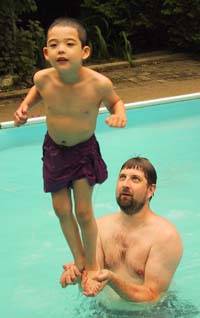
I can still do this, occasionally. Photo courtesy of Debbie Ohi.
 As soon as I post about Jon’s spelling they change the rules… Jon’s teacher decided that since he is spontaneously using so many tough words in his creative writing, his spelling tests from now on will feature the trickier words from those pieces (rather than words from the Dolch list). She figures this will improve his spelling in his writing, since those are words that he uses and thus are more relevant and meaningful to him.