All posts by Peter

Jon’s Wii Fit Career: An Update

Peter Meghan (and her whole family) dropped by a week ago, and very kindly stood in for Jon in his body test. And since then, he hasn’t been idle.

Jon has been on the Wii Fit every day, not only having a short or long run, but also doing Balance Games. He’s particularly fascinated by Ski Jumping, which consists of staying in a crouch, weight forward, then standing quickly at the end of the ramp (not jumping, you will lose all points). If you don’t extend quickly enough, or in Jon’s case, your foot pressure is mitigated by you pulling yourself up with your arms on your stander, you will fall off the ramp and roll down the hill, gradually becoming a huge snowball.

high up on the ski jump
The view from the top of the jump ramp

The first day, Jon was nothing but a snowball, but that was okay by him: it’s hysterically funny. The next day he announced he wanted to be a snowball again, and I thought, “Oh, my aching back. What a waste.” (since I have to assist with everything). But Laura happened to come in, and she focused on his feet (placing them, keeping them from turning—the uneven tone of CP makes even basic standing a tricky, unpredictable event), while I focused on his gently touching his thighs and torso to remind him how to stand. He gets to the end of the ramp and BOOM!…Jon was flying. And he pretty much has been since.

two photos: Jon in crouch and Jon in jump mode
Jon successfully jumping

Jon’s personal best is now 125 metres over two flights. But being a snowball is still pretty hilarious too.

Jon has also improved heavily in Slalom Skiing (as of today, he’s the reigning household champ) and Soccer Heading (beating my current score, but not Laura’s), but boy, a workout for him is a workout for me and Laura. As Laura keeps the feet more or less in position, I have to help Jon lean his torso, focusing his weight from left to right. It leaves my torso pretty tired. We can’t do more than 10 minutes at a time. It’s particularly interesting when he gets a bout of clonus in either foot, which completely confuses the Wii Fit balance board.

Between the walker and the Wii Fit, Jon is focusing more on pushing his weight into the floor, something we’ve been trying to work on for the past ten years. This bodes well for the future.

Joke Book Humour

Peter I can honestly say that I never thought the day would come where Jon would be entranced by joke book humour, the way many boys are, repeating their favourite corny joke over and over from a limited selection of all-corny jokes. Not that it’s a physical joke book, but an online collection at the Between the Lions PBS site. But the rest of the behaviour is identical, especially the uncontrollable cackling laughter that makes you wonder if he’ll die from asphyxiation or loss of bladder control first.

Then comes the swell of pride, since his favourite joke is a pun. Ah yes, Daddy’s boy. 🙂

Where does a cow go on Saturday night?
To the Mooooo-vies

Thanks, you’ve been a great audience. Try the veal.

Moment in Time

Peter Jon and Grandma. For the first time we risked bringing the walker to Grandma and Grandpa’s, instead of his wheelchair. Travel was slower, sometimes, but there was more effort and pride too.

Grandma and Jon

Look What Wii’re Up To! Or: An Open Letter To the Wii Fit Development Team

PeterSo Grandpa, through canny instinct and stealthy stake-outs, found a Wii Fit last month, and gave it to Laura for her birthday. We started into it immediately, but found it much harder than we had expected from the trailers. But we’ve hiked up our socks, and in our spare moments we’ve begun the various activities and started unlocking new games and exercises.

There’s a heart-breaking element to this though, and it’s Jon. We initially thought that because of his cerebral palsy, he wouldn’t be able to use the step-like Wii Fit Balance Board. Once he saw others playing it though, he was confused and sad, and couldn’t see why he couldn’t play. But I got an idea: why couldn’t we use Jon’s stander?

It seemed feasible. But sadly, the required body test just doesn’t seem to accept Jon on the balance board, even with the stander. It constantly would say he was shifting too much and asking to reset itself. We’ve tried about ten times over two sessions. Sigh. Jon has taken the disappointment well enough, but clearly his feelings are hurt.

At the cottage, he kind-of-cheated and used Meghan’s profile, which worked out about as well as possible. Jon can’t wait for Meghan’s next visit to our house, so she can fake a body test for him (they are roughly the same weight, and that’s all we need.)

In the meantime, using Grandma and Tamo’s profile, Jon has discovered running in the Wii Fit’s virtual park. It is the one game on the Wii Fit that doesn’t use the balance board. Instead it measures your energy through the bouncing Wii Remote in your pocket while you run in place in your living room.

At first, Jon just shook the Wii Remote with his hand, creating a super-fast running character who disobeyed commands to slow down, and thus tripped a lot. But then I had another idea…and it worked. It’s a more intensive version of his MEDEK wall exercises, and Jon loves it. And it makes a nice complement to Jon’s activities in his new walker. It’s a little hard on me, but with his enthusiasm…Go Jon go!

In the meantime, Wii Fit development team: you need to tune the Balance Board to include the disabled. You probably have a few hundred thousand or more in Japan to work with, or feel free to invite us over for some testing! Jon will work for sashimi and tempura!

Last week’s Neurological Fun

PeterSo what was I up to at St. Mike’s for two other days of the week?

Well, one day I was in a study of head injury cases, as they try to find the commonalities of concussion, and recovery from such. Of course, they can’t get a baseline measurement (you can’t do a “before” measure if you don’t know who’s going to get bonked on the head!), so they do a series of measurements periodically afterwards. This is for two reasons: to try and get a general idea of the pattern of recovery, and also to use the data as a guideline in testing the severity of a head injuries in Emergency.

At the end of that session, I had a follow-up CAT scan for both the study doctor and the neurosurgeon who oversaw me when I was in the hospital in June (and who had been considering opening my skull during the most stressful moments).

On Thursday was my 8 a.m. visit with Dr. Cusimano, whose resident gave me a detailed physical to see if I had lost any function. The good surgeon came in a little early, so he took over the second half of my examination. On occasion, he was quite stern with the student, making sure he understood the precision of the tests and not to asking leading questions. Since I had majored in Brain & Behaviour Psychology at Queen’s 20 years ago, I found this vaguely familiar and fascinating, and occasionally added my observations to help where the examination was lacking precision.

Aside from getting fatigued easier (and that is dissipating), I have only one noticeable after-effect from the head injury: my sense of smell is on the blink. It isn’t entirely broken, but there is always a predominant smell, which changes depending on certain circumstances. If I’m lucky it will be like now: lemon, or some other acceptable food smell. I have caught some smells on the fly—we got stuck behind a garbage truck the other day, which definitely was not filled with lemons 😉 . And it does heavily affect my sense of taste in the extra dimensions that are provided by smell.

But the doctor was starting to wrap up the interview by then, so he interrupted the resident’s summary of my smell report with “Ah! Anosmia!”—which is the complete lack of smell, and not what I have. He started quizzing his student about the construction of the words “anosmia” and “ageusia”. He then proceeded to show me (and provide me a print-out of) my CAT scan the day of the accident, and then two months later.

So let’s take a look, shall we? Okay so a quick summary of the head. You got yer skull, and you got yer brain, which is wrapped in the protective cushion layers called the meninges. The inner surface of the skull isn’t a perfect negative of the brain’s sulci and gyri, due to the protective meningal layers, but it does have the general contours.

If you whack your head right (ahem, this is foreshadowing) you can get the brain to jerk inside its protective cave, causing the meningal layers and maybe a little bit of brain to get ripped on the inner skull. Then comes the blood, which drips into the frontal cortex, and a bit into the back of the right temporal cortex. (The CAT x-ray images are flipped left to right and show two different levels of my brain.) The white blotches are blood.
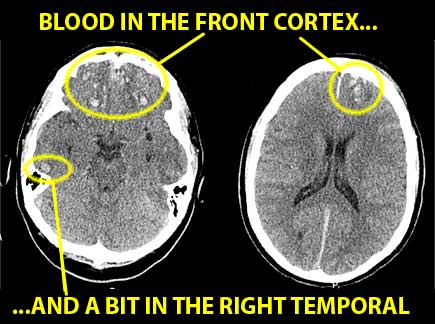
CAT scans of Peter's brain, hours after his fall

Those blood drops can screw up the neuronal activity something awful, and is the reason I don’t remember much of my next four days, including the devotion of my wife and parents through the many hours in emergency and my room (thank you folks, I’ll never be able to know what you went through), and have only patchy impressions of the visits of Reid and Andy. And remember, if I said anything stupid or embarrassing: remember, I call BRAIN INJURY!!!

Next up are shots from eight weeks later. They are rough approximations of the latitudes of the first two pics, but not exact by any means (the doc lined them up to print in about five seconds). Also, my conscious head is at a different horizontal angle than my unconscious head, so any major structural differences you think you see are not major damage. That said…there is subtle damage.
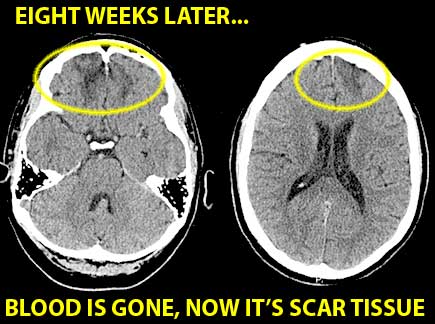
CAT scans of Peter's brain, 8 weeks after the fall

See that black shadowy powder where the blood splotches used to be? That’s glia scar tissue, reacting to the invading blood. (The glia cells are the subserviant cells to the brain cells (neurons), helping keep the chemical, oxygen and energy balance and generally being protective filler. In the brain they tend to inhibit the regrowth of severed neurons by forming scar tissue.)

So what does this damage mean? What have I lost? The doctor scoffed. “The brain is plastic, and with relatively light injury like this the functions remap within a week or two.” Since I’m not showing any of the known chronic signs of trouble: impulsive spending, bad memory, irritability, anger, depression, major bouts of crying, or trouble sleeping, and they can’t find any physiological trouble, things are pretty good, all things considered.

But then came the most negative comment by the doctor: My sense of smell. What’s the prognosis? “It could come back, but I wouldn’t bet on it.”

I will take this comment seriously, but with a grain of salt. He did tell his student that those nerves can regrow, but they are very fine. He didn’t quite have the right idea of how my sense of smell was affected. So remapping my sense of smell entirely may be quite difficult, or take a long time. But some of my reading on the subject suggests that this may not be neuronal at all, but due to sinus cavities issues like infections. Stay tuned.

And in the end, I’d rather the doctor be conservative in his predications, so I can exceed his hopes. And I’m sure Dr. Cusimano would be delighted to be wrong.

Last week’s Orthodontic Fun

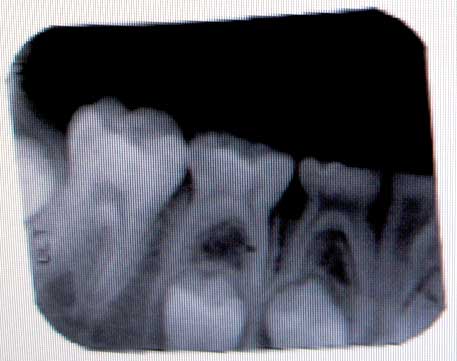
Jon lower molar xrays

Peter So last week was checkup week in the house, with me having two visits to St. Mike’s and Jon having a quick consultation with an oral surgeon in Whitby (when and if he does the tooth removals, he’ll do them at Sick Kids, but he likes to consult in his own office).

I’ll deal with Jon’s visit first, since it’s the easy one.

Fact: Jon’s progress on his baby teeth—or if your mail-order DDS diploma arrived today, deciduous teeth—is very slow. This is not a panic to us, as one of our nieces has this issue too, and everything is fine, just slower.

The orthodontist, Dr. Dagys, would like to remove Jon’s baby eye teeth (one per quadrant = 4) to give his front teeth a little room to spread out for a year or so, and gradually she’ll start her equipment magic.

The oral surgeon, Dr. Nish, thinks more removals are coming in the future, and that the eye teeth don’t buy too much more room. The removal of four teeth alone will require Jon to be anesthetized, and although anesthesia is relatively safe, there is always risk. Since he believes that Dr. Dagys is going to have him remove more teeth in the future, he feels that he should remove three teeth per quadrant (=12) in one fell swoop and Dr. Dagys can fit Jon with temporary dentures to fill the immense chewing surface gap. Mind you, Dr. Nish is a bit concerned by Jon’s late schedule, and admits that there’s a risk of Jon’s permanent teeth never emerging, despite their existence on x-rays.

Dr. Dagys has not told us about further removals, and when you combine that with the low, but real, risk of lack of the emergence of the permanent teeth, we think 12 at a time is a tad on the extreme side.

So we’re gonna let the two docs debate this one, and come back to us with a proposal that we can discuss. The nice thing is that both doctors are giving us a lot of the raw facts and their concerns, so we’ll be able to examine the new-and-improved proposed solution carefully.

Walker Delivery

Jon and his new walker

Peter Jon’s new walker has finally shown up. The delay wasn’t a supply issue, but rather a provincial co-funding issue, but I’ll rant about that another time.

It’s quite something to see Jon trying to surmount 11 years of not having to consider how to steer your body with your legs. Nothing in Jon’s experience has prepared him for a task like a U-turn, which is markedly different from anything he’s done before. On a therapeutic trike or wheelchair, it doesn’t require anything new from your legs: either they just sit there or they peddle, right? But a U-turn in a walker requires your legs to steer, perhaps cross-step, shifting weight while still keeping balance. Your brain has to make choices, and learn from mistakes. Muscles develop, and your strategies change.

This is the kind of thing you typically start to learn at 10 months or so, like our young buddy Rowan. Your butt is a full 12 inches from the ground, heavily padded by flesh and diaper and mistakes don’t cost much. And obviously, your legs grow strong as you wander more. It all fits together in a developmental ballet.

This is why many of Jon’s problems are referred to as “developmental delay”. Much of what he can’t or doesn’t do may be because of a lack of opportunity, due to low vision or other physical impediments that don’t allow him to take advantage of a relevant situation.

We’ll see how it goes. Yesterday evening, he proudly stood at the outdoor glass table and then reached forward to crank open the table umbrella. He’d never had that opportunity before. Developmental blocks shift and build. We’ll see how it will affect his footwork, his leg muscles, his hips, his posture…and his inquisitiveness…as we go.