 Bobby McFerrin has a way with an audience…
(via author William Gibson’s and @ColinPeters’s Twitter posts)
World Science Festival 2009: Bobby McFerrin Demonstrates the Power of the Pentatonic Scale from World Science Festival on Vimeo.
Bobby McFerrin has a way with an audience…
(via author William Gibson’s and @ColinPeters’s Twitter posts)
World Science Festival 2009: Bobby McFerrin Demonstrates the Power of the Pentatonic Scale from World Science Festival on Vimeo.
A month or two ago in his column in the Guardian, noted science-writer Simon Singh (who wrote a favourite of mine, The Code Book) laid a broadside against the chiropractic industry in Britain, as well as chiropractic in general. Based on the dubious history of chiropractic and the damning evidence of recent studies and key peer-review research, he criticized the industry’s claims of being able to treat many diseases. Furious, the British Chiropractic Association sued him for libel. Later the Association released their “evidence” list to shore up their case, none of which actually dealt with the issue at hand. In actual fact there is a great deal of evidence against specific claims (claiming chiropractic can treat children for ear infections, colic, asthma, feeding issues, etc.)
The libel trial held a preliminary hearing to determine the meaning of the BCA article. In a perplexing decision he judge decided that because Singh had used the adjective “bogus” to describe the treatments and had said that chiropractors had “happily promoted them”, he was accusing them of being deliberately dishonest. Singh argued otherwise. The judge indicated that he feels that is Singh guilty of libel, and the actual science has no part in this. Therefore, Singh was found guilty. That’s the antiquated world of British libel courts.
Singh has decided to fight. (He, not the Guardian, is paying for his own defence.) In response, the chiropractic organizations are in full retreat, one of the associations asking all of its members to take down their websites to avoid posting overreaching claims. One of the ways is that Singh is fighting is asking bloggers and websites to post the original article—now reviewed and edited slightly by lawyers.
So here it is.
Beware the Spinal Trap
Some practitioners claim it is a cure-all, but the research suggests chiropractic therapy has mixed results — and can even be lethal, says Simon Singh.
You might be surprised to know that the founder of chiropractic therapy, Daniel David Palmer, wrote that “99% of all diseases are caused by displaced vertebraeâ€Â. In the 1860s, Palmer began to develop his theory that the spine was involved in almost every illness because the spinal cord connects the brain to the rest of the body. Therefore any misalignment could cause a problem in distant parts of the body.
In fact, Palmer’s first chiropractic intervention supposedly cured a man who had been profoundly deaf for 17 years. His second treatment was equally strange, because he claimed that he treated a patient with heart trouble by correcting a displaced vertebra.
You might think that modern chiropractors restrict themselves to treating back problems, but in fact some still possess quite wacky ideas. The fundamentalists argue that they can cure anything, including helping treat children with colic, sleeping and feeding problems, frequent ear infections, asthma and prolonged crying — even though there is not a jot of evidence.
I can confidently label these assertions as utter nonsense because I have co-authored a book about alternative medicine with the world’s first professor of complementary medicine, Edzard Ernst. He learned chiropractic techniques himself and used them as a doctor. This is when he began to see the need for some critical evaluation. Among other projects, he examined the evidence from 70 trials exploring the benefits of chiropractic therapy in conditions unrelated to the back. He found no evidence to suggest that chiropractors could treat any such conditions.
But what about chiropractic in the context of treating back problems? Manipulating the spine can cure some problems, but results are mixed. To be fair, conventional approaches, such as physiotherapy, also struggle to treat back problems with any consistency. Nevertheless, conventional therapy is still preferable because of the serious dangers associated with chiropractic.
In 2001, a systematic review of five studies revealed that roughly half of all chiropractic patients experience temporary adverse effects, such as pain, numbness, stiffness, dizziness and headaches. These are relatively minor effects, but the frequency is very high, and this has to be weighed against the limited benefit offered by chiropractors.
More worryingly, the hallmark technique of the chiropractor, known as high-velocity, low-amplitude thrust, carries much more significant risks. This involves pushing joints beyond their natural range of motion by applying a short, sharp force. Although this is a safe procedure for most patients, others can suffer dislocations and fractures.
Worse still, manipulation of the neck can damage the vertebral arteries, which supply blood to the brain. So-called vertebral dissection can ultimately cut off the blood supply, which in turn can lead to a stroke and even death. Because there is usually a delay between the vertebral dissection and the blockage of blood to the brain, the link between chiropractic and strokes went unnoticed for many years. Recently, however, it has been possible to identify cases where spinal manipulation has certainly been the cause of vertebral dissection.
Laurie Mathiason was a 20-year-old Canadian waitress who visited a chiropractor 21 times between 1997 and 1998 to relieve her low-back pain. On her penultimate visit she complained of stiffness in her neck. That evening she began dropping plates at the restaurant, so she returned to the chiropractor. As the chiropractor manipulated her neck, Mathiason began to cry, her eyes started to roll, she foamed at the mouth and her body began to convulse. She was rushed to hospital, slipped into a coma and died three days later. At the inquest, the coroner declared: “Laurie died of a ruptured vertebral artery, which occurred in association with a chiropractic manipulation of the neck.â€Â
This case is not unique. In Canada alone there have been several other women who have died after receiving chiropractic therapy, and Edzard Ernst has identified about 700 cases of serious complications among the medical literature. This should be a major concern for health officials, particularly as under-reporting will mean that the actual number of cases is much higher.
If spinal manipulation were a drug with such serious adverse effects and so little demonstrable benefit, then it would almost certainly have been taken off the market.
Simon Singh is a science writer in London and the co-author, with Edzard Ernst, of Trick or Treatment? Alternative Medicine on Trial. This is an edited version of an article published in The Guardian for which Singh is being personally sued for libel by the British Chiropractic Association.
There is a good follow-up article in today’s Guardian.
 July 22 2009
I had a great day at camp. The first thing I did was go on the internet on a computer. And then I went to the gym to play bowling. Then I went to Arts and Crafts to make chalk.
I had a barbeque at lunch. I had some potato chips and a burger. I had ketchup, mustard and relish on my burger. After lunch I went to the Adventure Centre to play T-ball. After that I went to room 112 to have some ice cream. Then I went back to the gym to listen to some music. Camp was a lot of fun.
Jon
 I don’t usually enjoy wedding movies, but this one’s different. It was posted to YouTube only five days ago and it’s already become a web phenomenon. Does it qualify as a meme? At any rate, it’s guaranteed to make you happy.
Update: This is getting surreal: The newlyweds Jill and Kevin, and their attendants all appeared on the Today Show, recreating their dance in the middle of New York.
Anyone who’s taken psychology brain-and-behaviour courses has probably come across the gruesome case of Phineas Gage. In 1848, Gage, a 25-year-old Vermont railroad worker, was using a three-foot tamping iron to pack blasting powder in rock. The powder prematurely ignited, sending the 13-pound iron firing up into his cheek and through his brain, exiting from his frontal cortex. (See an animated illustration here.) Gage not only survived this horrifying accident, but was lucid and chatty on the way to the hospital, and his normalcy was later exhibited to amazed doctors. He died 11 years later.
The standard trope was then that Gage immediately started to show unpleasant personality changes due to his brain damage. The psych textbooks seemed to revel in Gage’s bad behaviour, pointing out how he became quarrelsome, alcoholic, neglectful of his appearance, choleric and unemployable. Interestingly, there is now controversy over whether these personality changes actually were as severe as has been quoted in textbooks. Certainly the fact that he managed to travel extensively and hold down jobs, one of them driving long-distance stagecoaches, suggests that if he did have personality changes they were not long-lasting or severe in nature.
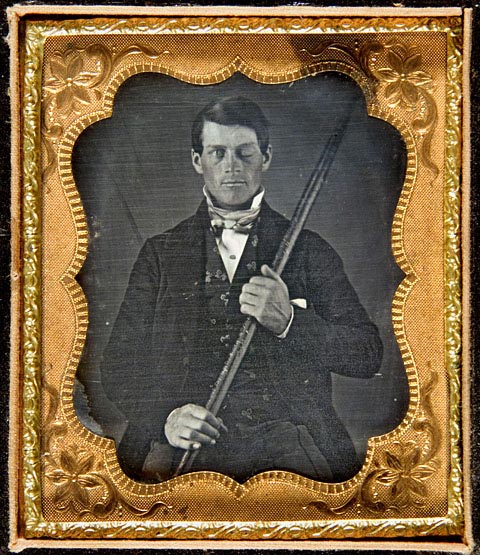
Daguerreotype from the collection of Jack and Beverly Wilgus
In 2007 Jack and Beverly Wilgus, a couple from Maryland, posted on Flickr a favourite photo that they had owned for several decades. It was a daguerreotype from the mid-1800s showing a dapper gent missing an eye, and posing with an odd, pointed object. They posited that the gent was an injured whaler with his harpoon, but were quickly disabused of that notion by commenters. The name Phineas Gage kept coming up, and intrigued, the Wilguses compared the photo to pictures of a lifecast made of Gage:
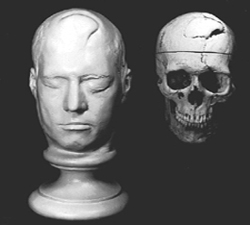
Lifemask (often incorrectly referred to as a deathmask) and skull of Gage
The pictures matched up perfectly, and if that weren’t enough evidence, on the object in their photo you could read part of the inscription that was known to be written on Gage’s actual tamping iron, “This is the bar that was shot through the head of Mr. Phineas P. Gage.” (Wilgus’s Phineas Gage website)
Though it’s hard to tell personality from a vintage photo—where people had to hold their pose for many seconds—one would like to think that this hale, assured-looking young man was not the profane wastral that he has been painted as through history.
July 18/09
I had a great first 2 days at camp. On Thursday I watched the movie Bolt. On Friday at camp I had drama in the music room, computers and sports. After those things I had lunch. For lunch I had Indian food I brought from home. I also drank some pink lemonade. I enjoyed the teddy bear picnic on Friday. I like camp. I had lots of fun.
Jon
(On Thursday Jon started his first day camp of the summer, a two-week session held at his school. I have no idea why they started the first session right after Canada Day instead of the following Monday. The ways of the Toronto School Board are strange and mysterious… —L)
July 9/09
I went to the Danforth with Mommy. I made three stops. The three stops were the magazine store, the bank and the Big Carrot. We looked at magazines at the magazine store. Mommy deposited money at the bank and I bought a bag of pepper chips at the Big Carrot.
I’m going to eat the pepper chips this afternoon.
Jon
(For this post I had Jon work on editing and spelling. I had earlier said to him that I was depositing money—he actually remembered the word (though not its meaning). Guess we’d better watch the cuss words around him from now on…—L)